How Your Driving Record Affects Car Insurance Rates in 2026: Points, Violations, and Premium Impact
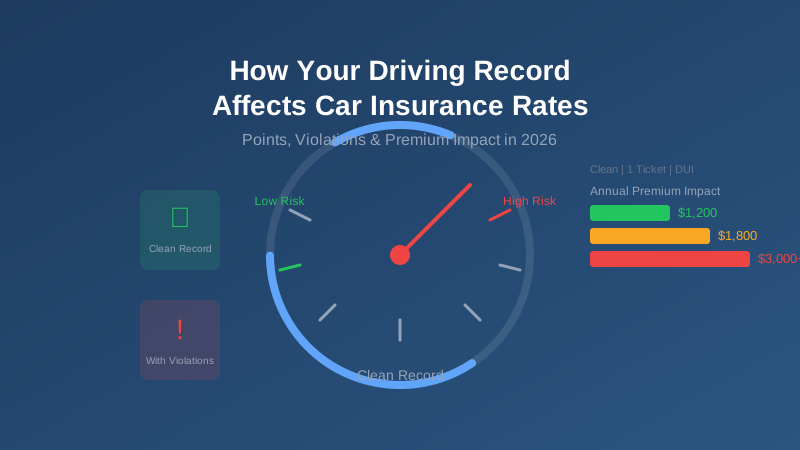
Your driving record is the single most important factor insurance companies use to determine how much you pay for car insurance — more influential than your age, your credit score, or even the type of car you drive. A single speeding ticket can raise your premium by 20% to 30%, while a DUI conviction can double or even triple your rates for years. Understanding how your driving record affects your insurance costs is the first step toward keeping your premiums as low as possible, whether you have a spotless record or a history of violations.
In 2026, insurance companies have access to more data than ever before. Telematics programs, state DMV databases, and third-party driving record services give insurers a detailed picture of your driving behavior. Even minor violations that you might think are insignificant — like rolling through a stop sign or driving 5 miles over the limit — can show up on your record and influence your rates. This guide explains the complex relationship between driving records and insurance premiums, what each violation costs you in real dollars, how long violations stay on your record, and what you can do to reduce the damage after a ticket or accident.
How Insurance Companies Use Your Driving Record
Insurance is fundamentally about risk assessment. The more likely you are to file a claim, the more you pay in premiums. Decades of actuarial data show a clear correlation between driving violations and future claims. Drivers with speeding tickets are significantly more likely to be involved in accidents than those with clean records. Drivers with DUIs pose an even greater risk. Insurance companies translate this statistical risk into premium surcharges that reflect the increased likelihood that you will cost them money.
When you apply for car insurance or when your policy is up for renewal, the insurer pulls your driving record from the state Department of Motor Vehicles (DMV) or through a third-party data provider. This report, sometimes called a motor vehicle record (MVR), includes all moving violations, accidents, license suspensions, and DUI convictions within a lookback period that varies by state and by insurer. The insurer then applies its rating system — a proprietary algorithm that assigns point values to different violations and calculates the corresponding premium surcharge.
Understanding Insurance Scoring
Insurance scoring differs from the point system your state uses for license suspensions. While your state assigns points to track violations for administrative purposes (too many points leads to a suspended license), insurance companies use their own scoring systems. A violation that carries 2 points on your state's DMV record might trigger a 25% surcharge with one insurer and a 40% surcharge with another. This variation is why shopping around after a violation can save you hundreds of dollars — different insurers weigh violations differently.
Most insurers use a tiered system where drivers are classified into risk categories: preferred (clean record, low risk), standard (minor violations, moderate risk), and non-standard (major violations, high risk). Moving from the preferred tier to the standard tier typically means a 20% to 40% rate increase. Moving into the non-standard tier can mean a 50% to 100% increase — and some insurers will refuse to cover non-standard drivers at all, forcing you to seek coverage from high-risk insurers that charge even more.
Which Violations Hurt Your Premium the Most
Not all driving violations are created equal in the eyes of insurance companies. Some are viewed as minor infractions with relatively modest premium impacts, while others are red flags that signal serious risk. Understanding the severity of each violation type helps you prioritize safe driving behaviors and know what to expect if you do receive a ticket.
| Violation Type | Average Premium Increase | Duration on Record | Risk Category |
|---|---|---|---|
| Minor speeding (1-10 mph over) | 15% - 25% | 3 years | Minor |
| Moderate speeding (11-20 mph over) | 25% - 35% | 3 years | Moderate |
| Reckless driving | 40% - 60% | 3-5 years | Major |
| Running a red light/stop sign | 20% - 30% | 3 years | Moderate |
| At-fault accident | 30% - 50% | 3-5 years | Major |
| DUI / DWI (first offense) | 50% - 100%+ | 5-10 years | Severe |
| Driving without insurance | 40% - 70% | 3-5 years | Major |
| Texting while driving citation | 20% - 35% | 3 years | Moderate |
| Careless driving | 30% - 50% | 3-5 years | Major |
| License suspension/reinstatement | 50% - 80% | 3-5 years | Severe |
The Real Cost of a Speeding Ticket
A single speeding ticket costs far more than the fine you pay to the court. Consider a driver paying $1,200 per year for car insurance. A modest speeding ticket (15 mph over the limit) could raise that premium to $1,560 per year — an extra $360 annually. Over three years (the typical time a speeding violation stays on your record for insurance rating purposes), that single ticket costs an additional $1,080 in insurance premiums alone. Add the ticket fine ($100 to $300 depending on the state) and court costs, and the total cost of that brief moment of speeding easily exceeds $1,500.
Annual cost example: $1,200 base premium → one speeding ticket = $1,500/year → second ticket within a year = $2,100+ per year. That is $900 in extra premiums annually from just two minor violations.
How Long Violations Stay on Your Driving Record
The length of time a violation affects your insurance rates depends on both state law and individual insurer policies. Understanding these timelines helps you plan financially and know when you can expect your rates to return to normal.
General Lookback Periods by Violation Type
Most insurers use a 3-year lookback period for minor violations like speeding tickets and red-light violations. Major violations like DUIs typically stay on your record for 5 to 10 years, depending on the state. At-fault accidents generally affect your rates for 3 to 5 years. In some states, insurers are prohibited from considering violations older than 3 to 7 years, but in others, there is no statutory limit on how far back insurers can look.
Importantly, the lookback period is calculated from the date of the violation, not the date of conviction or the date you paid the fine. For example, if you received a speeding ticket in March 2026 and paid it in May 2026, the 3-year lookback period typically starts from March 2026, meaning the violation would fall off your record for rating purposes in March 2029. If you successfully complete a defensive driving course to have the ticket dismissed, it may not appear on your MVR at all — and your insurance rates will not be affected.
| State | Minor Violations | Major Violations (DUI) | At-Fault Accidents |
|---|---|---|---|
| California | 3 years | 10 years | 3 years |
| Texas | 3 years | 5 years | 3 years |
| Florida | 3 years | 5 years (75-year lookback for DUI) | 3 years |
| New York | 3 years | 10 years | 3 years |
| Illinois | 4-5 years | 5-10 years | 3-5 years |
| Ohio | 3 years | 6 years | 3 years |
| Georgia | 3 years | 5 years (lifetime on record) | 3 years |
| Michigan | 3 years | 7 years | 3 years |
When Your Insurance Company Checks Your Record
Insurers check your driving record at several key points: when you first apply for a policy, at each renewal (typically every 6 or 12 months), and sometimes during the policy period if you add a driver or make significant policy changes. Some insurers use "soft" periodic checks to monitor policyholder records throughout the year. If a new violation appears between renewals, most insurers will not adjust your rate mid-term — the increase takes effect at your next renewal. However, if you are convicted of a DUI or your license is suspended, some policies require you to notify the insurer immediately, and failure to do so can be grounds for policy cancellation.
Strategies to Reduce Premiums After a Violation
Getting a ticket or being involved in an accident does not mean you are stuck with high rates for years. There are several proven strategies to minimize the financial impact of a driving violation and return to lower premiums as quickly as possible.
1. Take a Defensive Driving Course
Many states and insurance companies offer premium discounts for completing an approved defensive driving course — even if the course is not required by the court. In some cases, completing a defensive driving course can remove points from your driving record or prevent a violation from being reported to your insurer altogether. Even when it does not remove the violation, many insurers offer a 5% to 15% discount for completing an approved course. These courses are available online, take 4 to 8 hours to complete, and typically cost $25 to $50. The discount usually lasts for 3 years, making it one of the best returns on investment in car insurance.
2. Shop Around for Better Rates
Insurance companies weigh violations differently. One insurer might impose a 50% surcharge for a DUI while another applies only a 35% surcharge. After any violation, it pays to get quotes from at least 5 different insurers. You may find that your current insurer is the most expensive option post-violation, especially if you have been with them for a long time and they are no longer offering new-customer discounts. Independent agents who can quote multiple carriers are particularly useful after a violation because they know which insurers are more lenient on specific violation types.
3. Consider Usage-Based Insurance
Usage-based insurance (UBI) programs, also called telematics or pay-how-you-drive programs, track your actual driving behavior through a smartphone app or a plug-in device. For drivers with a violation on their record, UBI programs can be a lifeline. If you drive safely — obeying speed limits, avoiding hard braking, driving reasonable hours — the telematics data can override the negative signal of your past violation. Some insurers guarantee that safe driving data will reduce your rate regardless of your record. In 2026, over 20 major insurers offer UBI programs, and many drivers with violations see 15% to 30% savings compared to traditional policies.
4. Bundle Your Policies
Bundling your car insurance with homeowners or renters insurance typically saves 10% to 25% on both policies. After a violation, the bundle discount becomes even more valuable because it reduces the total dollar amount of the surcharge. If you already bundle, consider adding another policy — such as an umbrella policy or life insurance — to qualify for multi-policy discounts that can further offset the rate increase.
5. Increase Your Deductible
Raising your collision and comprehensive deductibles from $500 to $1,000 can reduce your premium by 10% to 20%. After a violation, when your rates are already elevated, this is an effective way to bring the monthly payment back down. Just be sure you have the cash available to cover the higher deductible if you need to file a claim. For drivers with violations, it makes even more sense to carry a higher deductible because your claims history is already working against you — avoiding small claims protects you from further rate increases.
6. Request a Rate Review at Renewal
When your policy comes up for renewal after the violation's lookback period has ended, contact your insurer and ask for a rate review. Insurers do not always automatically remove surcharges when a violation falls off your record. You may need to proactively request that your rates be recalculated based on your current driving record. If your insurer refuses to reduce your rate even after the violation has aged out, it is time to shop around — competitors will rate you based on your clean record going forward.
How to Check Your Driving Record
You have the right to review your driving record, and doing so regularly is an important part of managing your insurance costs. Errors on driving records are surprisingly common — tickets issued to someone with a similar name, incorrect reporting of accident fault, or violations that should have been removed after the lookback period. A mistake on your record could be costing you hundreds of dollars in unnecessary premium surcharges each year.
How to Obtain Your Driving Record
Request your driving record from your state's DMV. Most states offer online access for a small fee (typically $10 to $25). You have the option of requesting a 3-year, 5-year, or 10-year record. For insurance purposes, a 3-year record is usually sufficient for minor violations, but if you have a DUI or other major violation on your record, you may want the full 10-year record to see everything the insurer can see. Review the record carefully for any inaccuracies — incorrect violation dates, violations from another driver with a similar name, or tickets that should have been dismissed after you completed traffic school.
What Your Driving Record Contains
- Personal information: Name, address, date of birth, driver's license number
- Moving violations: All tickets for moving violations with dates, locations, and violation codes
- Accidents: Reported accidents with dates, circumstances, and fault determination (if available)
- License status: Active, suspended, revoked, or restricted status
- DUI/DWI convictions: All alcohol or drug-related driving offenses
- Point totals: Accumulated points under your state's point system
- Insurance history: Periods of coverage and any lapses (in some states)
How a Clean Record Saves You Money Beyond Lower Rates
Maintaining a clean driving record does more than keep your base premium low. Many insurers offer loyalty programs, accident forgiveness, and vanishing deductible programs that are only available to drivers with clean records. Accident forgiveness means your first at-fault accident will not cause your rates to increase — a benefit that can save you thousands of dollars over the life of your policy. Vanishing deductible programs reduce your deductible by a fixed amount for each year of accident-free driving. These programs are typically available only to drivers who have maintained a clean record for 3 to 5 consecutive years.
Additionally, drivers with clean records have access to the widest range of insurance companies. High-risk drivers are limited to a small number of non-standard insurers that charge significantly more. A clean record means you can choose from virtually every insurer in your state, use comparison shopping to your advantage, and switch carriers whenever a better deal becomes available.
Annual breakdown: Clean record = $1,200/year. One violation every 3 years = $1,500/year average. Multiple violations + at-fault accident = $2,200+/year average. The difference of $1,000/year invested over 10 years at 7% return = approximately $14,000 in lost wealth.
Conclusion
Your driving record is one of the most powerful levers you have over your car insurance costs. A clean record qualifies you for the best rates, the most discounts, and access to the full range of insurance carriers. Each violation, from a minor speeding ticket to a serious DUI, creates a financial penalty that extends far beyond the ticket fine — often costing thousands of dollars in higher premiums over several years.
The good news is that driving records are not permanent. With time, safe driving, and proactive strategies like defensive driving courses and telematics programs, you can minimize the impact of past violations and return to lower premiums. Checking your driving record annually, disputing errors, and shopping around at renewal time are simple habits that keep your insurance costs under control. Whether you are starting with a clean slate or managing the aftermath of a violation, understanding how your driving record affects your rates is the most effective way to avoid overpaying for car insurance in 2026.
For more detailed guidance on specific insurance topics, explore our car insurance claims guide or our complete collection of car insurance resources.
📋 Know Your Insurance Options
Understanding your driving record is just one piece of the puzzle. Browse our library of comprehensive car insurance guides to learn about coverage types, discounts, deductibles, and state-specific requirements. The more you know, the less you pay.
Start with our complete car insurance guide collection or learn about affordable coverage options for teen drivers.